: Complicity and Conspiracy in Film Translation
Songs of Opacity
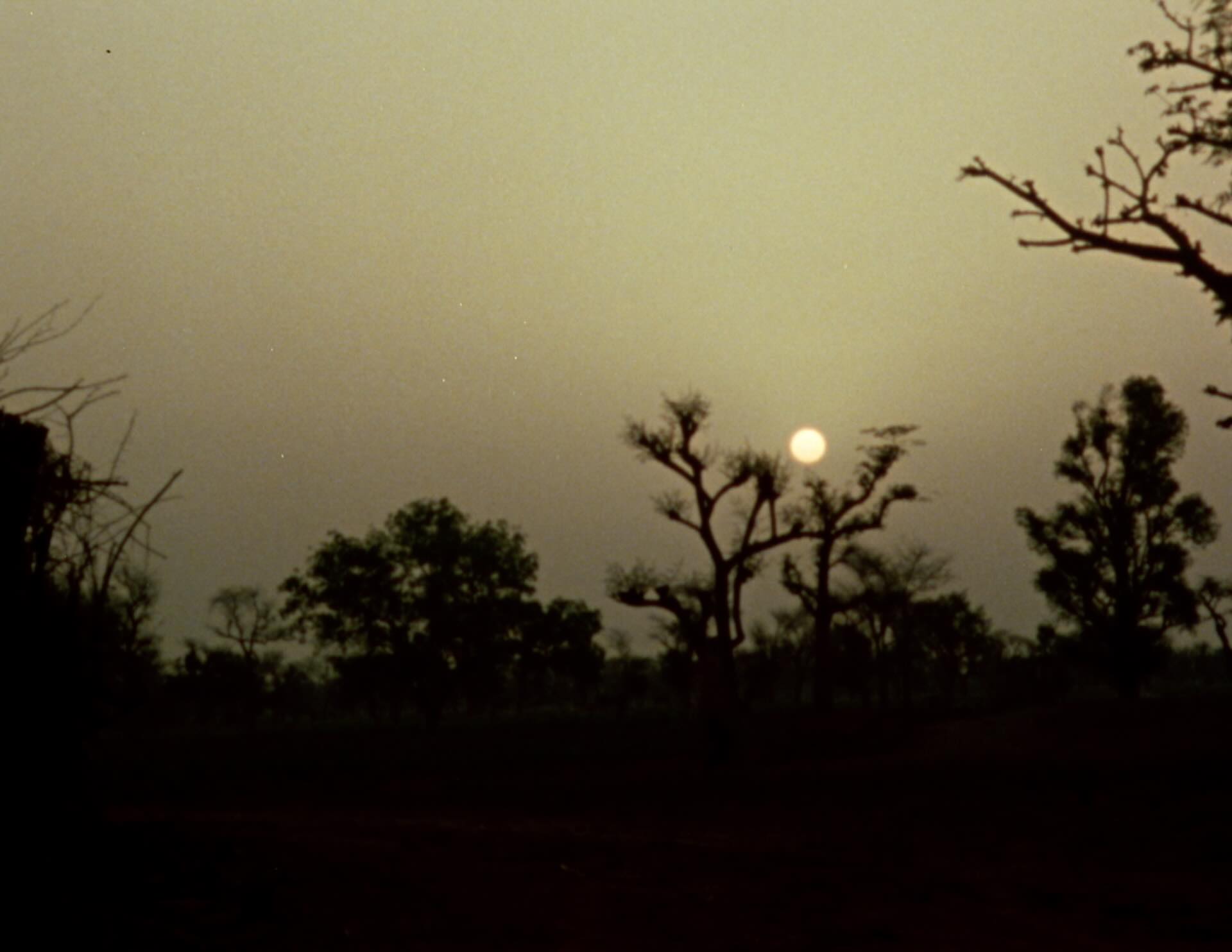
Still from Reassemblage (1982) by Trinh T. Minh-ha
Over the course of three days in March 2025, a first iteration of Complicity and Conspiracy in Film Translation took place in partnership with the Arab Image Foundation and Dawawine in Beirut. The program invited viewers to interact with the space of subtitles as a material to experiment with and a site where linguistic power relations are made visible. The screenings created opportunities for exchanges around various interactions with subtitles, shared by speakers and audiences alike. The movie watching experience transformed into a place where interplays between multiple languages were crystallized and thus revealed.
The idea was for this program to become an entry point for reflecting on our relationships with language and translation in the location where the event takes place. In the first iteration, I was keen on exploring the relationships between Arabic, Western Armenian and English, probing how these three languages, widely spoken in Lebanon today, intersect and shape one another. This also involved tracing the dynamics of marginalization, historical and cultural erasure as well as globalization; dynamics that govern the way these languages are practiced locally.
For the second iteration of this program, I am moving towards another cultural and linguistic context. Through a collaboration with writer and translator Omar Berrada and the team of LE 18, the program will engage with questions of subtitling and translation from the perspective of Morocco. How do these reflections on language that we raised in Beirut a year and a half ago echo in Marrakech today? The domination and gradual erasure of indigenous languages by Arabic, alongside the monopoly of French and English as cultural lingua francas, are issues that resonate across the two territories. What emerges with particular urgency in Morocco is how orality constitutes the defining state through which language is transmitted and preserved.
Entitled Songs of Opacity, this second manifestation of the Complicity and Conspiracy in Film Translation program suggests the audio-visual medium as a space that can host the complex and nuanced interactions between the oral and the written. Rather than providing an unquestioned access to another language, the films in this edition focus the subtitle as a threshold of connection and meaning in unusual and unexpected ways. The first session of the program brings together two films that unsettle the assumption that clear comprehension is an essential condition for engaging with the other. In Reassemblage (1982), Trinh T. Minh-ha refuses to subtitle sections of her film that includes speech in Wolof, Serer and other languages of Senegal. By doing so, the filmmaker disrupts our expectations of clarity and information when it comes to documentary filmmaking. Similarly, in جُرِن أُوكّرِيد [Land Listening], (2025), Philip Rizk delays the appearance of subtitles, allowing viewers to hear a voice speaking Nobiin (the Fadija Nubian language) without any accompanying text. He thus compels those who do not speak Nobiin to first listen to the voice itself, to linger on the rhythm and musicality of the language, before understanding it. This session opens onto language through its orality, moving away from the compulsive need for meaning and comprehension.
The second screening of the program further explores the negotiation between hearing and reading, as well as between listening and understanding. In Lesson 41 [Leckja 41] (1966), we attend a Polish language class for adult foreign learners filmed by Abdellah Drissi, a Moroccan filmmaker who moved to Łódź to study cinema in the 1960s. This film will be screened in its original Polish, without any subtitles. The viewers are invited to embrace the sense of disorientation this experience may provoke and focus on what is heard as well as how these immigrant individuals come into relation with this new language through their bodies and voices. Omar Mismar’s Lucía Méndez and the Peace in Lebanon (2015–2018) explores this embodiment of a foreign language through the politics of dubbing by staging a reading of sections from the Tai’f Agreement by the Mexican telenovela actress Lucía Méndez. After years of watching her lips move in silenced Spanish on television, we hear her voice for the first time, speaking Arabic to articulate (without understanding) the principles upon which the end of the civil war in Lebanon was negotiated. In Joe Namy’s Purple, Bodies in Translation (2017), we delve into the intricacies and contradictions of translating testimonies of war and violence. Here, subtitles and captions are not just tools for understanding dialogue; they become essential records that preserve the details and emotional weight of traumatic experiences that might otherwise disappear in translation. Extending these explorations, Eduardo Menz’s Pinochet’s Women [Las Mujeres de Pinochet] (2004), reconfigures the links between sound, image and text, dislocating their usual synchronicity, to confront the mechanisms through which a dictator’s regime narrates itself. The work thus prompts us to question the relationship between language, evidence, and the representation of political violence.
Finally, Սայաթ Նովա [Sayat Nova] (1969), Serguei Parajanov’s portrait of the 18th-century Armenian poet and troubadour, will be screened with Arabic subtitles created by Vartan Avakian and Hussein Nassereddine for the first edition of the program. This Arabic adaptation of the film’s original Armenian text seeks, through the act of translation, to recover the linguistic, historical, and cultural connections of West Asia that today appear invisible, if not impossible. Screening the film with these subtitles in Marrakech is an attempt to extend this act of recovery to North Africa. In fact, while preparing for this screening we realized that the figure of the troubadour – which Sayat Nova exemplified, աշուղ [ashough] in Armenian and عاشوق [ashouq] in Arabic – has its equivalent in Amazigh culture: ⴰⵎⴷⵢⴰⵣ [amdiaz] 1A special thank you to Omar Moujane, who is translating the texts of this program into Tamazight, for this find. Encountered in his text “اﻷرشيف الشفهي والذاكرة الجماعية وسؤال إعادة التفكير في اﻷرشفة” ; a figure that traverses these territories and languages through traditions of orality, poetry, and storytelling, where speech, memory, and song remain inseparable. In a related intervention, Trinh T. Minh-ha’s Reassemblage will be screened with Tamazight and Arabic subtitles. Produced for the project’s second iteration by Omar Moujane and Mahammad Hoogla-Kalfat, respectively, these translations expand the project’s multilingual network, bringing marginalized languages and cultures across North and West Africa into relation.
Indeed, in the film, Trinh T. Minh-ha reflects on filming in rural Senegal, saying: “I do not intend to speak about; just speak nearby.” This notion of speaking nearby echoes Edouard Glissant’s theory of relation in which he advocates the right to opacity as a way to interact with the other, to be in relation with them without necessarily fully understanding them, or rather by accepting that certain things will remain opaque, because the other is other. I find that subtitles create multilingual film experiences that can allow us to speak nearby, to stand in the opacity. They put languages in relation with each other, formally keeping both the source and the translation in the same space. This simultaneity allows the discrepancies in translation and the friction between the languages to surface. Subtitles are not seen here as a means to bridge the gap; they expose it and ask us to sit in it in order to allow for new meanings and experiences to arise.
This program is realized in the framework of NAAS’ curatorial fellowship 2025-2026
More information about the program here.

- 1A special thank you to Omar Moujane, who is translating the texts of this program into Tamazight, for this find. Encountered in his text “اﻷرشيف الشفهي والذاكرة الجماعية وسؤال إعادة التفكير في اﻷرشفة” ↩︎