: Complicity and Conspiracy in Film Translation
Songs of Opacity
Program
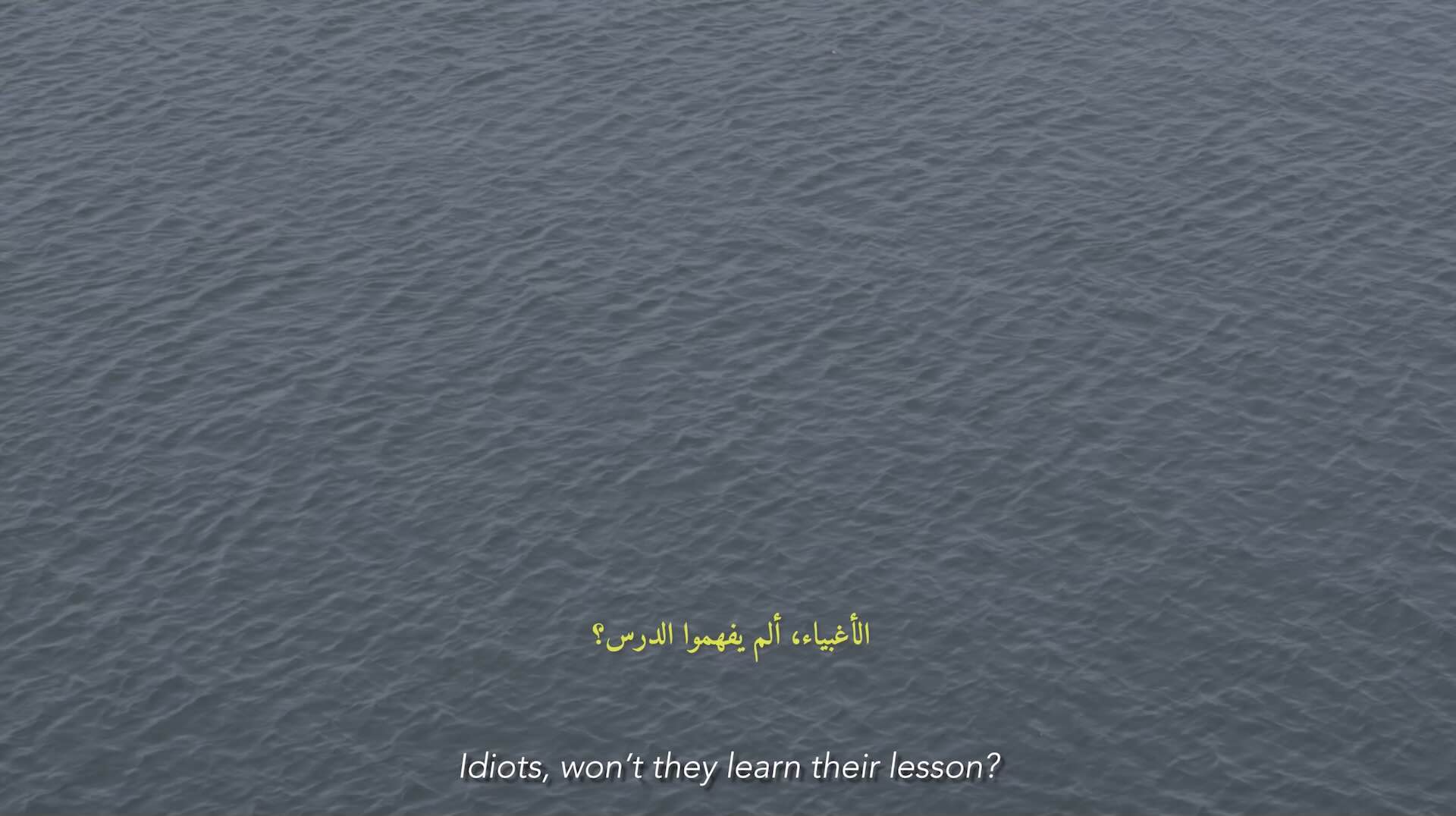
Still from جُرِن أُوكّرِيد [Land Listening] (2025) by Philip Rizk
Reassemblage by Trinh T. Minh-ha
1982 | Senegal | 40’ | in English with Tamazight and Arabic Subtitles | Thursday July 23rd at 9pm
A reflection on filming in rural Senegal and a critique of the anthropological eye.
“With uncanny eloquence, “Reassemblage” distills sounds and images of Senegalese villagers and their surroundings to reconsider the premises and methods of ethnographic filmmaking. By disjunctive editing and a probing narration this ‘documentary’ strikingly counterpoints the authoritative stance typical of the National Geographic approach.” — Laura Thielan
The film will be screened with a Tamazight and Arabic translation made by Omar Moujane and Mahammad Hoogla-Kalfat (respectively) in the framework of this program.
جُرِن أُوكّرِيد [Land Listening] by Philip Rizk
2025 | Egyptian Nubia | 15’ | in Nobiin (Fadija Nubian language) and Arabic with English translation | Thursday July 23rd at 9pm
The short film Land Listening features River People, who belong to a cosmology that entails relationships among all kinds of beings. Ever since the construction of dams, culminating with the Aswan High Dam in 1964 and the resulting dispossession of many Nubian communities from their ancestral lands and the severing of their close bond with the Nile, these stories have begun to erode. Will we let them expire?
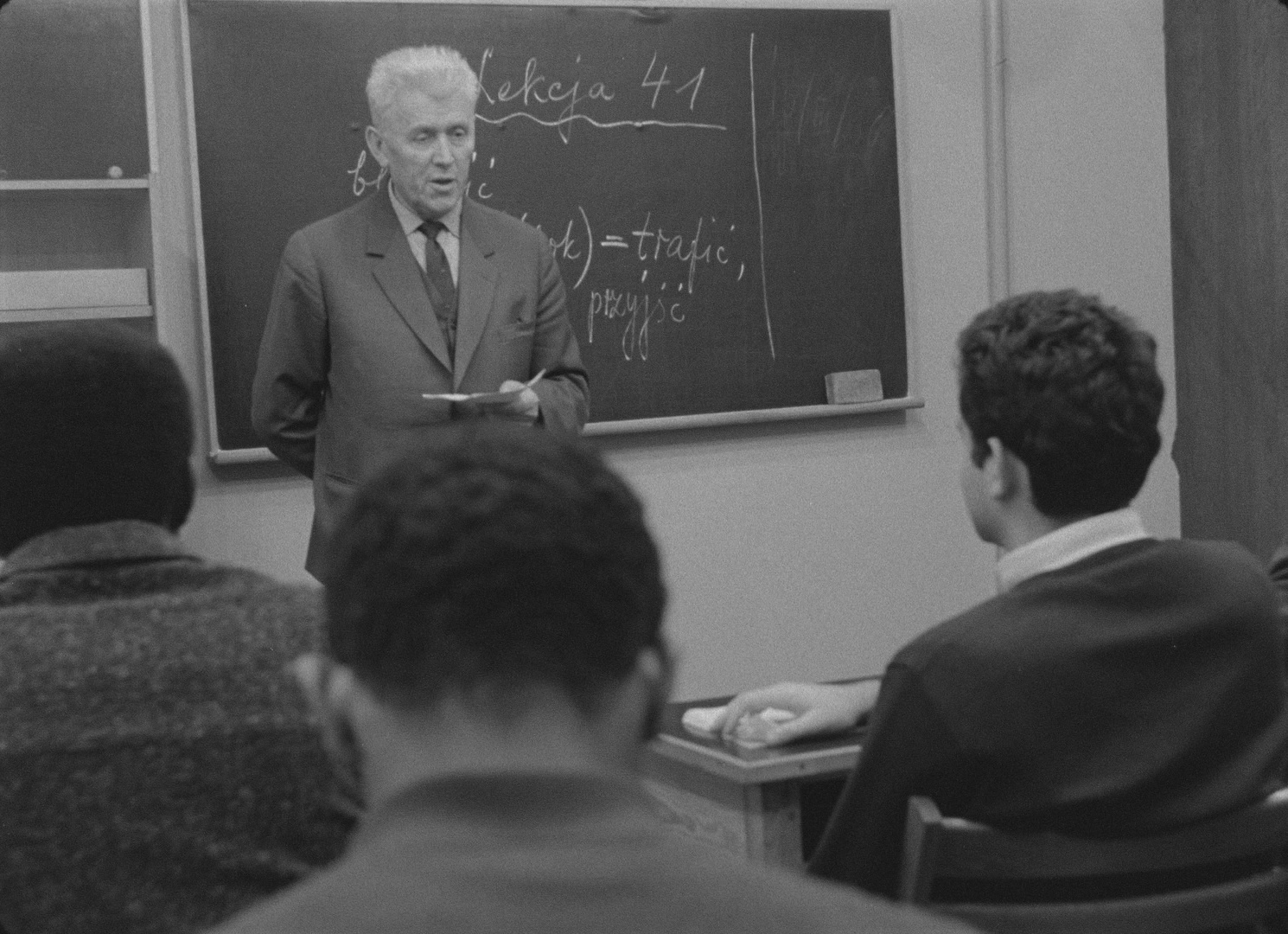
Still from Lesson 41 [Lekcja 41] (1966) by Abdellah Drissi
Lesson 41 [Lekcja 41] by Abdellah Drissi
1966 | Poland | 7’ | in Polish | Friday July 24th at 9pm
The film follows a Polish language class for adult foreign learners. An elderly teacher guides the students through the rules of correct pronunciation and grammar.
This film will be screened in its original Polish, without subtitles. The viewers are invited to embrace the sense of disorientation this experience may provoke.
Lucia Mendez and the Peace in Lebanon by Omar Mismar
2015-2018 | Mexico, Lebanon | 13’ | in Spanish and Arabic with Arabic and English Subtitles | Friday July 24th at 9pm
Tú o Nadie (You or No One) was the first Mexican telenovela to air in Lebanon, in 1992, shortly after the Ta’if agreement was signed. Actress Lucía Méndez was the beautiful and sensational Raquel, in front of whom viewers froze infatuated. While her lips swayed in silenced Spanish, we never heard Mendez’s voice, instead we heard an imposed one in Arabic. This work fancies a connection between the Ta’if, as a dub to the Civil War, and Lucía Méndez, as a representation of the post-war Ta’ifization of cultural production. This time, we hear the protagonist reading principles from the Ta’if in Arabic positing Mendez as a unifying symbol for warring factions.
Purple, Bodies in Translation by Joe Namy
2017 | Lebanon | 20’ | in English with Arabic Subtitles and English Captioning | Friday July 24th at 9pm
In Purple, Bodies in Translation the image is defined by what is heard––subtitled voices woven together with threads sampled from stories, poems, songs––all addressing the poetics of purple as a feeling. The film is centered around two texts by Lina Mounzer and Stefan Tarnowski that reflect on the intricacies of subtitling testimonials and videos from survivors of the war in Syria and the act of translation as an internalized process.
Las Mujeres de Pinochet [Pinochet’s Women] by Eduardo Menz
2004 | Canada | 12’ | in Spanish (Chilean) with English Subtitles | Friday July 24th at 9pm
A personal yet political video, Mujeres tries to show more than it shows. Feelings of theft and atrocity, truth and beauty, nationalism and memory are invoked for the viewers to experience as they are invited to role play through the repeated employment and alteration of the text, sound and image until his or her expectations have been truthfully realized. The video examines class structure, the meaning of beauty and forgotten history through two very different but significant women during Pinochet’s brutal regime of the late 1980s.

Still from Purple, Bodies in Translation (2017) by Joe Namy
Songs of Opacity : a conversation on language, translation, accessibility and circulation
Saturday July 25th at 6.30 pm
The audiovisual medium offers a space where the oral and the written intersect in complex and nuanced ways. Rather than simply providing access to another language, subtitles can become a threshold of connection and meaning, revealing dynamics of power, circulation, marginalization, erasure, and globalization that shape how languages are practiced locally and globally. This conversation will bring together researchers, translators, and activists to discuss their collaboration on this program and explore the role of language, translation and orality in their work.
With Omar Idtnaine (Researcher), Omar Moujane (Researcher & Activist) and Mahammad Hoogla-Kalfat (Researcher & Translator), moderated by Nour Ouayda (Program Curator)
Սայաթ Նովա [Sayat Nova / The Color of Pomegranates] by Sergei Parajanov
1969 | Soviet Union | 76’ | in Armenian with Arabic Subtitles | Saturday July 25th at 9.00pm
A portrait of the 18th-century Armenian poet and musician Sayat Nova, the ‘King of Song’. Through his poetry and a series of lavish tableaux, the film charts his life from humble weaver, to king’s minstrel and monk before being martyred during the Persian invasion of his monastery.
The film will be screened with an Arabic translation made by Vartan Avakian and Hussein Nassereddine in the framework of this program.
Sayat Nova was restored by Cineteca di Bologna / L’Immagine Ritrovata laboratory and The Film Foundation’s World Cinema Project, in association with the Cinema Foundation of Armenia and Gosfilmofond of Russia. Restoration funded by the Material World Foundation.
Followed by a discussion with Vartan Avakian (Artist)
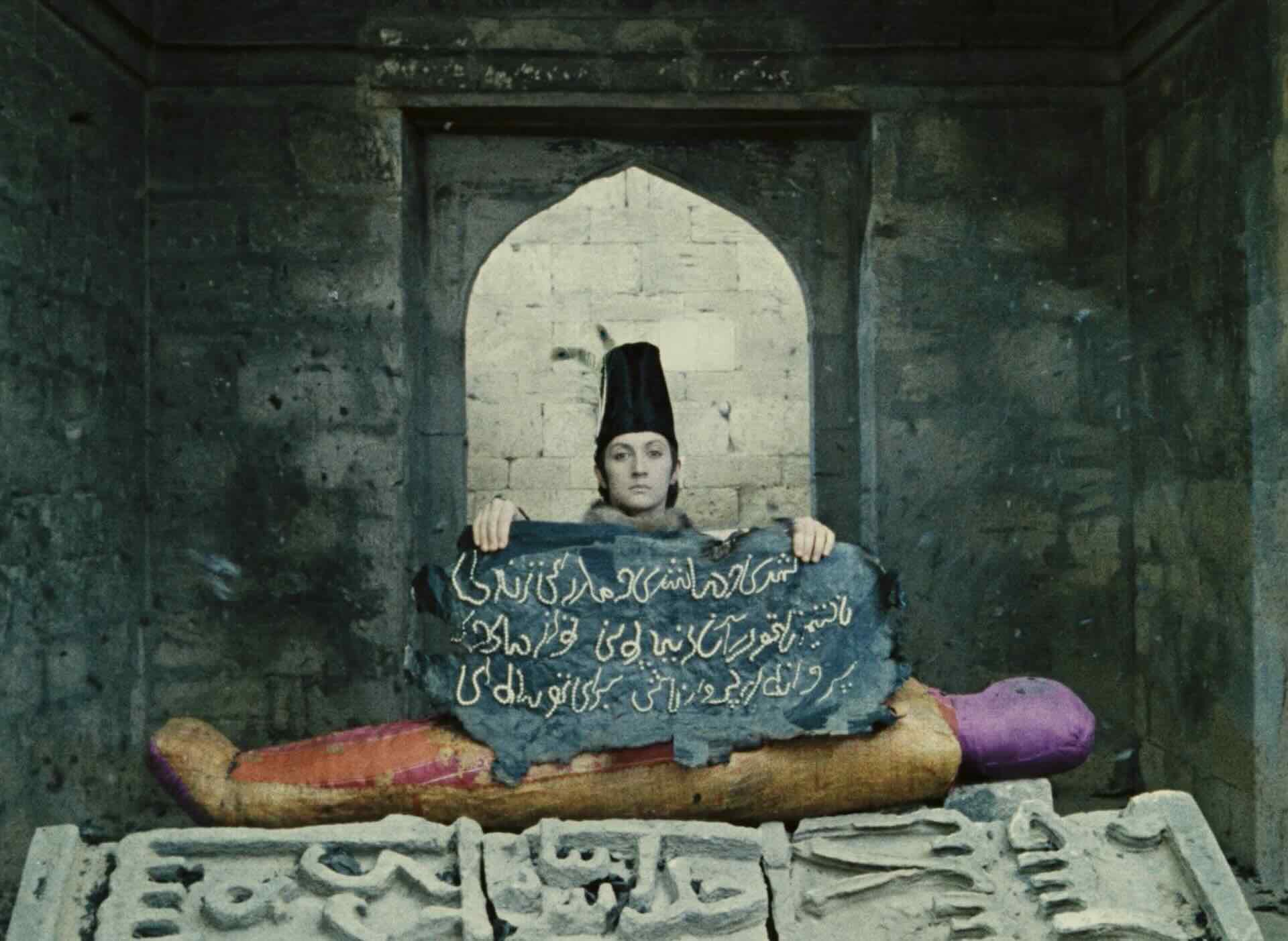
Still from Սայաթ Նովա [Sayat Nova] (1969) by Sergei Parajanov
Vartan Avakian is an artist working with video, photography, and sculpture. He is a board member of the Arab Image Foundation.
Omar Berrada is a writer, translator and curator whose work focuses on the politics of translation and intergenerational transmission. He is the author of the poetry collection Clonal Hum and the editor of several volumes, including Album: Cinemathèque de Tanger (2012); The Africans, on racial dynamics in North Africa (2016); La Septième Porte, a history of Moroccan cinema by Ahmed Bouanani (2020); and Another Room to Live in: 15 Contemporary Arab Poets (2024). His writing was featured in numerous exhibition catalogs, magazines and anthologies. Born and raised in Casablanca, he currently lives in New York.
Abdellah Drissi (born in Morocco) is a graduate of the Superior School of Dramatic Arts of the National Theater of Strasbourg and the Film and TV Direction Department of the Łódź Film School (1964–69). Director of the student shorts The Register 4105 (1970) and Lesson 41 (1966), which received the Warsaw Documentary Film Studios Award at the Łódź Film School Student Shorts Festival. His master’s thesis was “From the Brothers Lumière to Godard: Foreign Cinematography in Morocco.” Former assistant director at the Jaracz Theater in Łódź. Director of UNESCO-commissioned documentaries about North Africa and newsreels for CCM.
Laila Hida is a Moroccan artist and cultural worker based in Marrakech. Working across photography, installation, publishing, and curatorial practice, she explores the ambivalence of images as both archival material and generators of fiction. Her recent research, Le Voyage du Phoenix, examines photography, literature, and cinema as tools that shaped the twentieth century’s regimes of desire. In 2013, she founded LE 18, a multidisciplinary art space and residency in Marrakech, and initiated Dabaphoto, an annual program dedicated to photography and image-making in Morocco.
Mahammad Hoogla-Kalfat is an Egyptian writer, cinéaste and translator, among other things, currently working on a project titled “Egyptian cinema and the spectres of communism” as a NAAS Research and Curatorial Fellow, and a book, Taghṭiyat al-‘Ury (“Covering the Naked”) as an AFAC Creative and Critical Writing Grantee. Future projects include a feature documentary, Attakka!: Stopping by Nubian Ruins, and a translation of CLR James’s The Black Jacobins: Toussaint L’Ouverture and the San Domingo Revolution.
Omar Idtnaine, an independent researcher, focuses on the topics of memory, heritage, and art history. He has published several articles and conducted a wide range of research. He is also a member of several organizations dedicated to heritage and culture.
Born in Vietnam, Trinh T. Minh-ha is a filmmaker, writer and composer. Her work has received several awards and grants and her films have been given over fifty retrospectives. The conceptualization of cultural heritage as transgressing borderlines informs her work as both a filmmaker and a literary theorist. Trinh Minh-ha has traveled and lectured extensively. She taught at the National Conservatory of Music in Dakar (Senegal), at universities such as Cornell, San Francisco State, Smith, and Harvard (USA) and she is Professor of Gender & Women’s Studies and of Rhetoric at the University of California, Berkeley.
Eduardo Menz is a filmmaker based in Montreal, Canada. He is a member of the Double Negative Collective who showcase international experimental filmmakers’ works and exhibit their own films and videos at numerous festivals internationally. Eduardo’s film work has always attempted to transgress and interweave the boundaries of what defines fiction, documentary and experimental film genres. His films and videos have been shown at several distinguished festivals worldwide and have won awards at Brooklyn Film Festival, Big Muddy in Illinois, NextFrame Touring Film Festival in the U.S., Les Rendez-Vous du Cinema Quebecois in Montreal, Hot Docs and Images Festival in Toronto.
Omar Mismar is a visual artist based in Beirut. Project driven, parasitical, and medium promiscuous, his work takes up conflict and desire as they shape the everyday via documentary approaches, material interventions, translational strategies, and play. These investigations have produced a dérive through form, from photography, sculpture, and mosaics to performance, installation, and film.
Omar Moujane is an Amazigh activist committed to environmental issues, extractivism, and the resistance of marginalized communities, and a doctoral student in sociology at Hassan II University in Casablanca. His research and political engagement focus primarily on local resistance to mining projects and extractivism, particularly the Movement on Route 96 in Imider. In collaboration with artistic collectives, he has been involved in projects related to the struggles of indigenous peoples, the preservation of Amazigh oral tradition, and environmental justice.
Joe Namy is an artist, composer, and educator whose practice encompasses sound, its history and impact on the built environment. Working collaboratively through public sculptures and performances, Namy’s work considers the social construction of sound and the political forces that enable its transmission. The artist’s work also critically engages with the gender dynamics of sound, migration patterns of instruments, and translation between languages, between score and sound, and between instruments and bodies in movement and dance.
Hussein Nassereddine is a multidisciplinary artist living and working between Beirut and Paris. His work originates from a practice around language that builds fragile monuments rooted in collective histories and resources of songs, poetry, and time.
Nour Ouayda is a filmmaker and film programmer. She explores the multiple relationships between image, text, voice, and sound, through filmmaking, curating, research and writing. Between 2018 and 2023, she worked at Metropolis Cinema Association where she developed the Cinematheque Beirut project. She is part of the editorial team of the Montreal-based film journal Hors Champ and a member of the artist collective The Camelia Committee. She also teaches film programming in Beirut.
Sergei Parajanov is a filmmaker and screenwriter. He was born in Tiflis, Georgia (then part of the Soviet Union) to Armenian parents. He first studied singing and choreography in his city of birth and later attended the VGIK film school in Moscow, going on to work in Ukraine, Georgia, Armenia and Azerbaijan during the Soviet era. His films are imbued with the cultures, traditions and myths of these countries and captivate due to their singular power of expression, unmistakable originality, complex visual compositions and radically free cinematic form. Parajanov’s artistic daring and the cultural diversity expressed by his films was met with hostility in the Soviet Union. Interventions on the part of the censors were followed by fake trials, prison sentences and working bans. He is regarded internationally as an exceptional filmmaker and is one of the most fascinating figures in 20th century cinema.
Philip Rizk is a filmmaker and writer from Cairo, currently living in Berlin. In his films Out on the Street (2015), Mapping Lessons (2020) and Terrible Sounds (2022) he uses performance and the technique of montage to experiment with methods of “making the habitual strange”. In a world that is breaking down, a question that runs throughout Rizk’s projects is “how do we prepare ourselves for what is to come?”. You can follow his work @ filfilfilm.com.
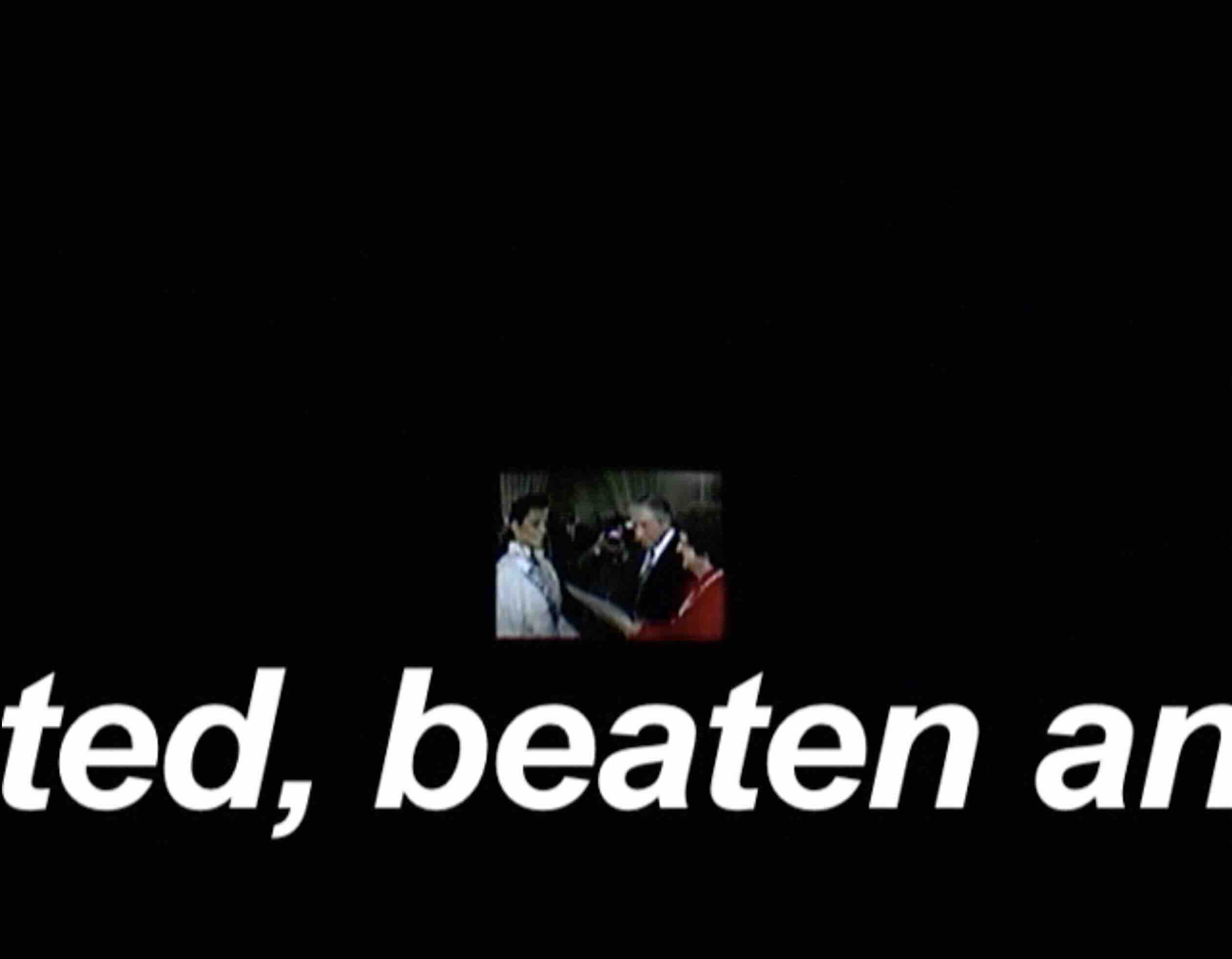
Still from Las Mujeres de Pinochet (2004) by Eduardo Menz